 he story of Echmiadzin
and the beginning of
he story of Echmiadzin
and the beginning of
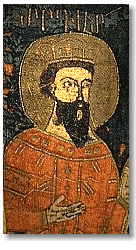
the Armenian Apostolic Church is tied to the story of King T'rdat III
and Grigor of Parthia. Persian Sassanids had invaded Armenia, killing
King Khosrov and eliminating the Armenian Parthian ruling class. When
T'rdat returned to Armenia in 288 AD leading a Roman legion, he reclaimed
his kingdom and attempted to force the country to adopt the old pagan
religion, which was based on the cult of Vahagan, Anahit and the sun goddess
Mythra, which had been converted by the Sassanids to Zoroastrian fire
worship.
T'rdat--a fervent pagan, began a series of persecutions against the Zoroastrians, attempting to reestablish the old religion. He also participated in Rome's repression against the growing Christian cult. Among his noblemen, and a favorite, was Grigor, the son of the man who had assassinated his father, and who had secretly converted to Christianity at Caesurae.
Legend has it that T'rdat ordered Grigor to imitate other officers in his retinue and place a wreath of flowers before an image of Anahit. When Grigor refused, declaring himself a Christian, he was subjected to torture. Learning that he was the son of the man who murdered his father, T'rdat had him thrown into chains and sent to Artashat, where he was imprisoned for 13 years in a dry well known as Virab.
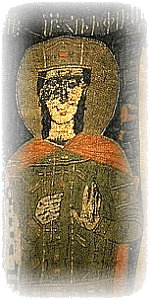
A second story intertwined with this is that of Hripsimeh, Guyaneh and the 37 Maidens (also known collectively as the 39 Maidens). Lusted after byboth T'rdat and Diocletian, emperor of Rome, the maiden was a Chirstian, and spurning T'rdat, was stoned to death with her nurse, Guyaneh. T'rdat is proportred to have gone mad, and only when he freed Grigori and repented of his sins was he made sane.
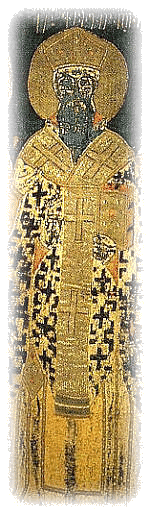
T'rdat then became just as fanatic a Christian as he was a pagan, demanding his family, the entire court and military convert as well. When Grigor was ordained archbishop in Caesurae, the entire royal house went with him and were baptized in the Arazani branch of the Euphrates River, at Pakeritch. This precipated 300 years of gradual conversion of the country, referred to as The Pagan Wars.
Dates vary on this event, the church insisting all key events occurred in 301, but others saying public records of the time show it occurred in 311, while others say 314-316 AD. The doubters question how an Armenian king under the protection of Rome would convert at the height of Roman persecutions against Christians, with the most virulent persecutor, Galerius, in their own neighborhood.
Others counter that a conversion would have been perfectly timed in 301 AD, since the Romans were actually in a period of decline in the region, Galerius had begun to suffer form the disease that eventually caused his conversion and death, and a counter move had to be made against the popular Zoroastrian religion which had permeated the local population, threatening to assimilate the country into the Persian Sassanid empire.
By converting to Christianity, and then appointing Grigor (also a Parthian) as the first patriarch or Katoghikos over the Armenian church, T'rdat insured continued Parthian control over both government and religion.
An third point of view says that both sides are right, and that there were two conversions, the second cementing the conversion and making a public declaration of the fact, as records show that in 301 AD pagan temples in Armenia began to be converted into churches.
Whenever it occurred, Grigor (also referred to as Grigor Lousavoritch or Gregory the Illuminator; Surp Grigor or St. Gregory) and T'rdat did team up and began an immediate campaign to squash the old religion, beginning with the Temples of Vahagan and Anahit at Ashtishat in Mush (in present day Turkey). Ashtishat means "place of many gods", and was the primary center for the pagan religion in Armenia. They continued with the temples at Iriz Til Tartan and Ani-Kemagh.
Soon the "crusade" was nationwide. Pagan statues and icons were smashed or melted down, and crosses were set in their place. Of the tens of thousands of pagan statues only a fragment of one bronze statue, the head of Anahit, survives, housed in the British Museum. It is believed by many that among the icons destroyed were all records of the early or old Armenian script, considered pagan and unholy, to be replaced with the Greek and Syrian used in the Christian rites of the Near East. This would be easy to do, since Latin and Greek had become the languages of the court centuries before.
Of the thousand or more pagan temples in Armenia before the conversion, only one--the reconstructed temple at Garni--survived. All other temples were demolished, over which new churches were built. This was the case for Echmiadzin, as Grigor commanded the new church built over the ruins of the old temple.
The crusade was not always peaceful, with rich and powerful pagan priests pitted against the Armenian Royal house. Many Katoghikos' were martyred in this period, among them Grigor's progeny Vertanes, Aristakes, Nerses, and Husik Petros, who was bludgeoned to death in a dispute over the construction of a church. Many pagans were killed as well, and the 4th century is also alluded to as the period of Holy War. The complete conversion of the state took centuries, and was not considered complete until just before the Arab invasion in the mid 8th century.
History