s
you return to the cathedral on the northern face, you can see the different
strata of construction, beginning with the main wall, which has blocks
of stone from the original 301-303 AD edifice, inscribed in Greek, the
language used before the adoption of the Mashtots Armenian Alphabet (ca.
405 AD). You can also see angled cornices in the upper wall, which show
where the original roofline was.
s
you return to the cathedral on the northern face, you can see the different
strata of construction, beginning with the main wall, which has blocks
of stone from the original 301-303 AD edifice, inscribed in Greek, the
language used before the adoption of the Mashtots Armenian Alphabet (ca.
405 AD). You can also see angled cornices in the upper wall, which show
where the original roofline was.
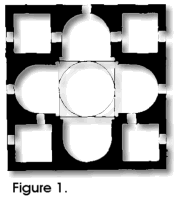
A reconstruction of the original design [FIGURE 1], shows that the original church had a central "drum" topped with a conical roof, and four smaller "drums" over the four corner chapels. An extensive renovation of the cathedral in 484-486 under the patronage of Prince Vahan Mamikonian transformed the church into a central plan, protruding walls out at the cardinal points (the semi-circular walls below the small domes). Raising the roof to its current level, a central dome, probably made of wood, was set above the entire edifice.
The dome was built in 618 AD under the patronage of Katoghikos Komitas I, as were four smaller ones at the cardinal points. Alterations were made to the large and small domes in 1627, the western dome was replaced by the bell tower in 1658 and bas relief carvings were added to the facade.
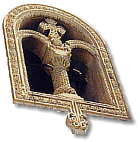
The carvings found on the outside of the church include the twelve apostles on the facets of the drum and carvings of the evangelists and St. Gregory on the bell tower. Around the drum of the main dome is a series of 48 stone "seals", elaborate geometric patterns including a Star of David.
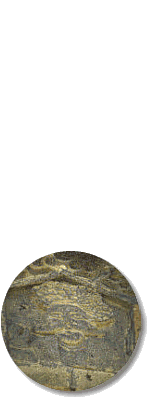
Look just above the arch supporting the northern dome. In place of an apostle or evangelist, a likeness of Shah Abbas I (20) appears, linked with history and legend. The story goes that in the early 17th century the Persian army was advancing on Echmiadzin to destroy the cathedral. Overnight the carving the Shah appeared, and when they army arrived, they were asked if the Shah wanted to destroy his own image. Hearing that his own likeness was on the face of the church, the Shah became its protector instead, lavishing gifts on the cathedral.
Katoghikos Tombs (21,22)
The graves on either of the bell tower are for eleven Katoghikos from the 19th-20th centuries, each of which had a profound impact on events of their time. Most written in Grapar or old Armenian, they are the most asked about and least deciphered monuments in the complex:
a. Ter Ter Khoren I - 1873-1932-1938
b. Hovhannes R. Karbetsi - d. 25 March 1842
c. Gevorg IV - b. 5 July 1813 d. 6 December 1882
d. Ter Matevos II Kostandnapoletsi (from Constantinople) - b. 22 Feb. 1845 d. 11 Dec. 1910 - (Katoghikos) 1908-1910
a. Daniel I Payetsi - 39 Oct. 1808
b. Nerses V Ashtaraketsi - b. 13.02.1761 d. 13.02. 1857
c. Mkrtich I Vaneti (Khrmian Hairik) - b. 4 Apr. 1820 d. 29 Oct. 1907
d. Gevorg VI - b. 2 Nov. 1868 d. 9 May 1954
e. Vazgen I - 1908-1955-1994
f. Ter Ter Gevorg V T'p'khisetsi - 1911-1930 - b. 28 Oct. 1847 d. 8 May 1930
g. Makar I - b. 13 Apr. 1813 d. 16 Apr. 1891
Bell Tower
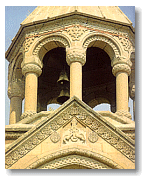
Built in 1658, the Bell Tower is richly adorned in the "Armenian Oriental Style", which borrows inspiration from both the Persian and European classical styles. The eight sided dome is set above heavily carved arches and pediments.
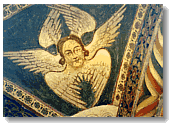
The interior of the dome is covered with frescos and painted carvings, crowned by 8 six-winged cherub heads. The winged cherub is repeated throughout the cathedral design and on Armenian chalices, vestments and scapulars. The figure bears striking resemblance to ancient Mesopotamian and Urartian winged figures found on temple walls.
Why six wings? In sacred numerology the number six was considered a perfect number (the sum 3+3, or 1+2+3, or 2x3; 3 was considered the holiest number, and now stands for the trinity). In the bible God created the heavens and earth in 6 days, Christ died in the sixth hour of the sixth day. It was considered the number before the end and the resurrection in early Christian symbolism.
There are eight sides to the dome with eight supporting mantels. The first number after seven (connected with celestial life), eight was considered the symbol of life, the new life after baptism (both in pagan and Christian times). In Christian belief, the resurrection of Christ occurred on the eighth day. The octagon is the favored form for the baptismal font and conical domes.
The painted carvings on the mantels is some of the most interesting artwork. Each mantel is a unique design with three geometric seals and animal imagery. Flanking each upper seal are male and female pelicans, ducks, geese, cockerels, falcons, peacocks, storks and bluebirds. Between the lower two seals are a Stag, Boar, Lion, Unicorn, Goat, Bison and two carvings of an Elephant.
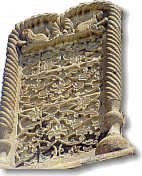
The outer walls, arches and pillars are carved with geometric patterns, grape vines, plants and intertwining lines. The carvings on the upper arches depict two snakes (also called dragons) with open mouths. The symbol of wisdom, snake imagery is pre-Christian in origin, gloriously usurped in this design motif. The whole is a baroque fantasy surprisingly in harmony with the solemn 5th century exterior.
Cathedral Exterior
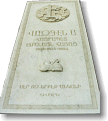
Vazgen I