South Hall
The museum houses but a portion of the church treasury, but is still impressive with its collection of relics, artifacts, church vestments and tapestries. It is not possible to describe each item in detail, but the most notable items on display are (by display case):
a. 18th century Flabellum and Dove Chrism. The flabellum is rimmed with bells which ring during the Eucharist.
b. Reliquary of Noah's Ark of silver and gold.
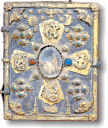
c. The centerpiece is the Reliquary of the Thorn of Christ. Silver and gilt Scripture covers, chalices and crosses.
d. Psalters, reliquaries and silver crosses.
e. Relic of St. Andreas.
f. Meron Vessel, 19th century
g. Painting of Vazgen I, 20th century
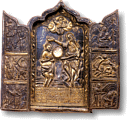
h. Among the silver, gold and bronze reliquaries and crosses is a small wooden panel, the 9th-10th century Amenaprekich (All Savior) of Havuts Tsar which represents Christ's descent from the cross. In the center of this composition is Jesus with cross-adorned halo, long curly hair, being lowered by two workmen, one holding a pair of pliers to pull the spikes out. The overall artistic concept as well as the details resembles Gothic sculpture.
i. One the most impressive display cases holds The Relic of Geghard in a 1687 silver reliquary. "Geghard" means "spear", and the relic is believed to be the spear that pierced Christ's side. The relic was originally kept in Geghard Monastery (Vank). The two gold reliquaries hold the Relics of St. Thaddeus and St. Bartholomew, a gift from Pope John Paul II .
j. Among the silver chalices from the 17th-19th centuries is the 13th c S. N'shen Reliquary, originally housed at Saghmosavank.
k. Patriarchal staffs of silver, wood, ivory, gold and inlay.
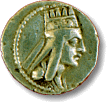
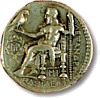
l. Coins. The oldest coins in the treasury collection date from the 5th century BC. The early coins were struck in Greece and Asia Minor, with representations of classical Greek and Hellenistic figures. Hellenistic Coins are silver struck with the portraits of Alexander of Macedonia and the Seleucid kings. The center piece is the King Tigran the Great Coin, from the 1st. c BC.
m. Manuscripts from the 14th-16th centuries, silver crosses encrusted with amber and jewels.
East Hall
n. Shah Abbas I lamp, 17th c gift from the Shah to the church.
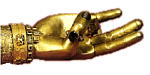
o. Right Hand of John the Baptist Relic of silver, gold and jewels. On loan to exhibitions, but normally housed are the Right Hand of St. Gregory and the Right Hand of Thaddeus, both of gilded silver with filigree and jewels. The hand is held with the tip of the middle finger touching the tip of the thumb. The circle formed represents the world, while the three remaining fingers symbolize the trinity.
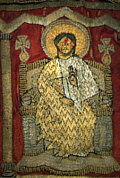
p. 17th-19th centuries Vestments of silk, gold and silver thread, beaded with pearls and jewels.
q. 1799 St. George Slaying the Dragon, hand woven tapestry from India, measuring 63 sq. meters.
North Hall
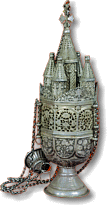
r. 17th-18th century silver and bronze Censors and vessels. The crystal crosses date from the 10th cenury and include the Altar Cross of Ani (966)
s. Bust of Komitas, based on death mask.
t. Komitas Crown on the center shelf.
u. 18th-19th century Vestments
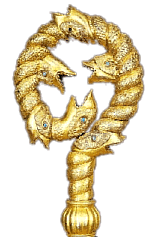
v. Collection of staffs. One of the most unique symbols developed by the Armenian church are found in its staffs. Repeated use of the Vishap (dragon, which in old Armenia was a snake-like fish) motif evolved into Christian symbolism on the staff mounts. The designs are very close to those found on dragon stones from pagan times. The demons are always framing a central cross that was mounted above, or formed into a spiral pattern. A stunning example of the way the symbolism remained while the exterior design changed are two spiral staffs.
A 17th century gold staff is surmounted by six snakes entwined together so that only their heads are free. Close to it is a 19th -century staff that has reduced the realistic picture of the snakes to a baroque fantasy of gilded blooms and leaves. But look closer and you will still find the six snakes; the ‘heads’ are the gilded flowers, the leaves their jaws, and they are swallowing or ejecting the next head of blooms.w. Russian Icons, 17th-18th century.
Cathedral Museum
Enter the museum on the south side of the high altar through the door under the painting Grigor Lousavoritch Taken From the Tree.
The museum is closed during services, otherwise open Tuesdays through Sundays from 9 am to 5 pm. No admission, but guides encourage donations.