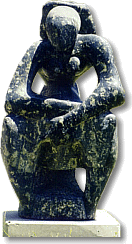
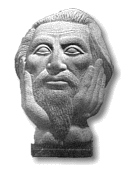
he museum displays sculptures, graphics and paintings created by a Diaspora Armenian who was one of the foremost sculptures of the Modern Art Movement in the 1940's-1960's, and whose most famous works can only be seen here. Unfortunately, there are no guide booklets in English, and the displays are all labeled in Armenian.
The museum (tel: *5 20 38) is located 100 meters south of H’raperak on the eastern side of Araratian Poghots. It is across the street from the Gevorkian Seminary.
The museum is open Tuesday to Sunday from 9 am to 5 pm during May - October, and 10 am to 4 pm during November - April. Admission is 50AMD, and donations are appreciated.
Background
Born Khoren Ter Avetissian in 1909 in Ashotavan Village in Western Armenia (present day Turkey), Ter Harutian barely escaped the 1915 genocide. Except for his mother, a sister and the artist, his entire family (23 members, including his father, a priest, and brother) were killed by Turkish soldiers. In 1921 they immigrated to the USA, and Ter Harutian then moved in 1930 to Jamaica, where he began his painting career.
In the 1930's he traveled to England where he became interested in sculpture, first working with wood (lignum vitae, mahogany, eucalyptus, satinwood) and later in stone, almost exclusively in marble. His graphics and paintings have a slight resemblance to the work of Salvador Dali, but the content is less intellectual, much more visceral in their depictions of human tragedy and hope.
In 1982 Ter Harutian gave 100 sculptures, 250 graphics and 50 paintings as a gift to Armenia. First housed at the Komitas Museum in the old seminary next to the Cathedral Complex, the collection was moved to its current location in 1994 when the church repossessed the seminary building. Originally a cinema, the space displays 79 of Ter Harutian's works in the lower level. Others are stored in the upstairs cinema hall. Abandoned by state subsidy (staff salaries are US$10 a month), the director and staff of the museum work completely out of devotion for the artist's legacy.
Plan of Khoren Ter Harutian Museum
Outside the Museum
In the niches on the upper wall are two large sculptures made in 1949 from Georgian marble.
On the left is Pillar of Salt (1) and on the right is Hope (2) , both from a series based on Sodom and Gomorrah.
From right to left on the ground level are David Sassountsi (3), Mother of the Cliffs (4) (dates unknown, marble) and Fertility (5) (1966, serpentine marble).
The two bronze plaques are miniatures of the Life of Mher series, done for a Philadelphia exhibition in 1976.
Inside the Museum
The entrance lobby and main hall displays the bulk of the collection including Ter Harutian's Genocide Series (25 graphics, 1 painting, a large bronze plaque and a huge bronze statue of a vulture perched over a decaying corpse), the marble sculptures Rhythmic Dance, Euphrates Foam, Echo (19), Leda and the Swan (57) and Man of Sorrows (32).
Others include Ani (16), Awakening Man (52), Catching Fish (29), Do Not Kill (21) and Struggle for Life (23).
A remarkable piece is Descent from the Cross, a massive carving from Georgian Marble on rough timber. The figure is sculpted like a death mask in the medieval period, yet appears as installation art.
Ter Harutian combined Urartian monumental design with figures from Armenia's Christian era, as in his Vartan Mamikonian, Sacrifice and John the Baptist.
Take a look at Gorilla and Tragedy and you seem to be peering into two sides of the same mirror.
Khoren Ter Harutian Sculpture Museum (73)
Guided tours in English, French and German arranged with advance notice (1,000AMD singles, 5,000 AMD groups)