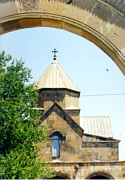
Complex
For this tour, see GUYANEH VANK plan. Points appear inside "()" of this plan.
As you enter the complex through the main gate (1), you pass through outer gardens and a small graveyard. Along the eastern wall are two long buildings, the old seminary (2), now a Sunday School, and the rectory (4), built in 1652, along with the churchyard gate (3).
The inner courtyard has a large garden and the church plaza. To your far right as you face the church is the mataghatun (mah-tah-ghah-TOON) or sacrificial house (5). Matagh (mah-TAHGH) or sacrifice in Armenia continues much as it did in pre-Christian times, the faithful bringing sheep, doves or pigeons (as they can afford) to the orh'nakar (or-h'-nah-KAHR) or blessing stone (6), which is about 20 meters from the church portico.
The church does not officially condone sacrifice, but it will bless the animals with salt outside the church. Long discounted by urban Armenians, the ritual is steeped in rural tradition, and is perhaps the strongest link between modern Armenia and its pagan past, performed as an act of thanks or intercession. The meat is divided into seventh's, distributed among seven needy families. Sacrificial sheep are slaughtered and dressed at the mataghatun, which also has a dining area.
A fountain (7) is located in front of the seminary building. Located on the north, east and southern sides of the church is a graveyard (8). Three old khachkars (9a, 9b, 9c) stand just beyond the southeast corner of the church.
Guyaneh Vank (81)