Interior
For this tour, see GUYANEH VANK plan. Points appear inside "()" of this plan.
The church is a triple nave basilica and is distinguished from earlier churches with its integrated central dome. The 7th century was a period of architecture innovation as cruciform domed churches began to replace single, double and triple nave basilicas, and the great cylindrical cathedral at Zvartnots allowed Armenian architects to master large dome engineering.
Guyaneh is a transitional building between early medieval (early Christian) and middle or high medieval (first golden era), with the roof line imitating the cruciform style topped with a barrel dome of the later period, while the interior remains an earlier period basilica divided into three naves by support columns. Four large columns and their arches support the dome.
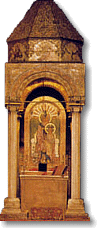
The most arresting image on entering the church is the 17th century marble canopy over the altar (18), which protected the Ijman Seghan at Echmiadzin Cathedral until brought to Guyaneh in the 1980's. The decorative design and the figures of God the Father, God the Son and God the Holy Ghost are by the Hovnatanian family, and were painted directly on the marble, as was the Madonna and Child on the main altar piece, which is a renovation of the original 7th century stone altar.
Other paintings in the church are from the 19th-20th centuries, except the large one hung above the entrance to the crypt. The painting of S. Guyaneh (20) hung over the entrance to the crypt is by Hovnatan Hovnatanian.
The Katoghikos Throne (19) is from the 16th century, brought to Guyaneh when the mother of pearl throne in Echmiadzin Cathedral was restored in the 1980's. It is richly carved with biblical symbols and mounted like the other thrones with a model of the church as seen in Grigor's vision. Unique to Armenia is having a Katoghikos throne in a church other than the Mother See, a sign of favor not lost on the members of this church.
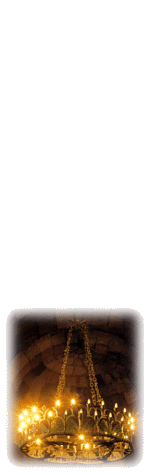
Just under the dome is a wrought iron chandelier (under dome), designed in a ring of doves. Hripsimeh Vank has a chandelier just like it. Legend has it that the center point directly below the dome and chandelier is the location where a shaft of light in the shape of a cross appeared to Grigor in his vision, showing him the location of Guyaneh's relics. Another shaft of light is also believed to have appeared at the spot where Hripsimeh was buried, directly below its central dome.
That center point is believed by church workers to have curative powers, and one lively guide told us how the insane and people with seizures have stood under the chandelier and been cured. Even non believers have reported feeling a slight energy pulse by standing under the chandelier for a few moments. Truer than fiction? You decide.
The entrance to the crypt (21) is to the right of the altar. The stones in the first room or inner chapel were in legend hand carried by T'rdat III from Mt. Ararat as penance for ordering Guyaneh's execution. Doubtful though that story is, they are among the stones used to build the first Martyrion in the 4th century.
Follow the steps to your left and you will enter the crypt, situated directly below the altar. The large black monument (21a), carved from a single block of marble and inscribed S. Guyaneh is often mistaken for the site of her grave. To the left of the entrance is a niche in the wall which is directly below the altar, and the actual location of the saint's relics (21b).
Our guide almost relished telling us the painting illustrating her martyrdom is not accurate. In fact, it was much more gruesome: Guyaneh's tongue was cut from the back of her throat before she was stoned to death, so that her cries would not disturb the king's sleep.
Guyaneh Vank (81)