Background
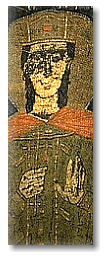
Hripsimeh's martyrdom, as well as those of Guyaneh and 37 other Roman maidens precipitated King T'rdat's madness and later conversion to Christianity. As such, Hripsimeh is often sited as the determining factor in the conversion of the nation.
One tradition says that Hripsimeh was the daughter of a Roman nobleman, and was to be wedded to the Roman Emperor Diocletian. A Christian, Hripsimeh escaped with Guyaneh and the other maidens to Armenia. Diocletian sent a message to T'rdat ordering him to capture the maidens, offering Hripsimeh as a reward if T'rdat wanted her. If not, he asked T'rdat to return Hripsimeh to Rome so he could have her. Hripsimeh is described in legend as the most beautiful maiden in the empire, and T'rdat fell madly in love with her at their first meeting.
One of the more interesting legends says that with each advance T'rdat was rebuked by Hripsimeh in more and more eloquent ways. Suspecting Guyaneh of coaching escapes from his advances, T'rdat commanded his soldiers to silence the older maiden. They did this quite effectively, cutting off her tongue before stoning her to death. Hripsimeh and the remaining maidens were kept in the palace for several month's while T'rdat attempted to persuade Hripsimeh to marry him. However, Hripsimeh became more and more eloquent in her refusals, finally declaring she could not wed one when she was already promised to another. Furious, T'rdat demanded to know her suitor. "Christ," was the reply, and in a rage T'rdat had Hripsimeh and the rest of her entourage beheaded, their bodies buried in a common burial site.
Just after this, T'rdat became gravely ill, raving like an animal. Medieval drawings and carvings depict his insanity by placing the head of a wild boar on his head, and the more vivid legends interpret this literally to mean he turned into a pig. Actually the depiction is a symbolic one, meaning he had become "subhuman", since wild boars were considered among the most subhuman animal Armenians knew.
T'rdat's sister Khosrovadukht (literally, "daughter of Khosrov"), herself a Christian, then had a dream where she was told that the only way to cure the king and save the nation was to release Grigor. She convinced T'rdat to free Grigor and come into his presence. Having survived 13 years imprisonment in the virab at Artashat (legends say through the kindness of an old woman who threw bread and drink into his pit), Grigor came before the king in rags covered with the train of his hair and beard. Laying his hand on the head of the king, he is believed to have immediately cured him of his insanity.
The original martyrion was built in the 4th century over Hripsimeh's burial site and was reconstructed in the 5th century as a two story monument (a 5th-6th centuries picture of the monument can be found carved on the southeast stele at Odzun Vank in Northern Armenia).
The present church was built in 618 AD under the patronage of the Katoghikos Komitas I. This was during the twilight of Armenia's first golden age, 20 years before the first Arab invasions brought a violent end to an intense flowering of culture and independence. As such, it is considereed a crowing achievement of Armenian architecture, its proportions a perfect representation of the cosmos and sacred geometry for that time. The bell tower was added in 1790.
Hripsimeh Vank (26)
The vank is open 9am to 6pm seven days a week.