Complex
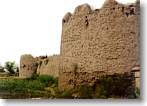
The fortress walls and towers (1), were originally built at the same time as the church, rebuilt numerous times, and are believed to have originally been more than 15 meters high. These standing are probably reconstrucionts from the 15-17th centuries. When first constructed, Hripsimeh was a fortress-vank. Persian and Roman invasions had already decimated the royal city of Echmiadzin-Vagharshapat, and complete conversion had not yet occurred. Lying half way between Echmiadzin and Zvartnots (which was still a pagan temple at the time), Hripsimeh was literally a fortress for Christians in the wilderness.
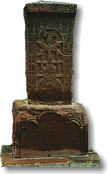
As you enter the vank from Mashtots Poghots, you will pass the 18th century rectory (3), and a Khachkar (4), date unknown. Immediately to your left, under the plaza are the only public toilets (5) in Echmiadzin.
Up the stairs is a large plaza (6) surrounding the church, with Khachkar and carving fragments lining the eastern wall (7). A new akhpiur or memorial fountain (8) is immediately behind the main apse of the church.
At the entrance to the church are two graves (4, 5) for Armenian Katoghikos. The one on the left (9) reads "Ter Ter Karapet Ulnetsi (from Ulneh) Katoghikos 1726-1729" and the other (10) reads "Ter Ter Astvatsatar A. Hamadantsi (from Hamada) 1715-1725".
Hripsimeh Vank (26)
The vank is open 9am to 6pm seven days a week.