Interior
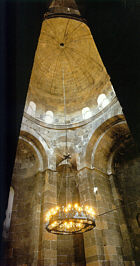
Originally the inner walls were covered with frescos depicting the crucifixion, annunciation, the Apostles and S. Grigor and Hripsimeh, but they were lost long ago. Even without the original frescos, the masonry and angular niche patterns show a mastery of craftsmanship.
At other early churches central pillars support the dome, but Hripsimeh's dome covers the entire central hall, and the support fluting gives the illusion of lightness that defies the dome's massive weight. The engineering was such that the church survived intact several severe earthquakes.
During renovations in 1959-1962 a number of segments from the previous structures were discovered in the foundation of the church, and can be seen underneath glass floor plates.
To your left as you enter the church is a large 12th century Khachkar (A), an early example of the open cross form (where the stone is completely cut through). Just beyond it in front of the northern apse is a gravestone (B) engraved "1104 year 25 March died Haghbaktsi (from Haghbak) Ter Pilip Pos Sakia Katoghikos". This is a rare example of someone other than a martyr being interred within a church.
The paintings (C) covering the altar platform wall are a reconstruction of original fresco work, depicting the Virgin and Child flanked by The Apostles and Ss. Stepanos and Pilipos.
The altar (D) is newly carved from light brown stone, showing pomegranates (symbolizing love) and grapes (the blood of Christ) flanked by eagles (supreme power).
The painting Astvatsatsin over the altar is 20th century. Over the southern apse and door is the large 17th century painting of S. Hripsimeh (E) by Hovnatan Hovnatanian.
As you face the altar, the entrance to the Crypt (F) is to the left. The first room has fragments of Khachkars and inscription stones, as well as an old wood and bronze door. To enter the crypt, go into the unlit passageway to the right and down the steps.
The crypt's design, like the martyrion at Guyaneh, has its roots in the pre-Christian period, and resembles Urartian sanctuary design, as well as the inner sanctuary at Garni. In fact, the size and proportions are proportionately identical to the sanctuaries of Sushi at Erebuni and Mythra at Garni.
Armenian crypts are probably inherited from these traditions via the Roman and Syrian catacomb tradition. On the outskirts of the Roman Empire, Christians in Syria adopted the Semitic tradition of Mesopotamia regarding the individual construction of tombs, cut into rock, or partially or completely excavated below ground level. The entrance usually featured a façade preceding an antechamber. The design of Hripsimeh and Guyaneh Martyria closely follow this example.
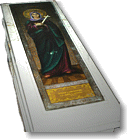
The inner chamber of the Martyrion holds the remains of Hripsimeh (G) behind the wall to your right as you enter. A 1986 painting of the saint is on the large marble sarcophagus (H) in the center of the chamber. Next to it in a small wall niche (I) is a glass window protecting a black stone, which is believed to have been one used to crush Guyaneh's head. You'll need a flashlight to see it in the dimly lit chamber.
Hripsimeh Vank (26)
The vank is open 9am to 6pm seven days a week.