Dynasties
The Nairi
 t
start of the 2nd millennium, trading between the tribes on the Armenian
plateau had already led to a loose federation led by the Nairi, which
were based around Southern Lake Van. The Nairi were recorded as early
as 2000 BCE on Assyrian cuneiform as the people from the "land
between the rivers," holding about 60 tribes and 100 cities. The
Nairi were one tribe among many, but their name became synonymous with
that for the entire region. Among the tribes in Nairi was one called
Urartu.
t
start of the 2nd millennium, trading between the tribes on the Armenian
plateau had already led to a loose federation led by the Nairi, which
were based around Southern Lake Van. The Nairi were recorded as early
as 2000 BCE on Assyrian cuneiform as the people from the "land
between the rivers," holding about 60 tribes and 100 cities. The
Nairi were one tribe among many, but their name became synonymous with
that for the entire region. Among the tribes in Nairi was one called
Urartu.
The Founding of Echmiadzin? Urartu
As early as the reign of the Assyrian king Shalmaneser I (1280-1266 BCE), the first mention of Urartu is made, under the name "Uruatri". By the 11th c, the Nairi tribe was usurped by the Urartuans for hegemony in the region, and Assyrian cuneiforms from this period record the first mention of Urartu as a strong power. By the 9th c. the Urartu kingdom had established its regional power far beyond its capital at Tushpa (present day Van), invading Mesopotamia, and unifying the tribes in the Armenian plateau into one centralized state.
The Urartian King Argishti I crossed the Arax River and penetrated to the Ararat Plain ca 786. He and his son, Sardur I expanded the empire as far as both shores of Lake Sevan, and to the edges of modern Georgia, incorporating most of the territory of modern Armenia into its reaches. The founding of Echmiadzin is sometimes traced to this event.
A cuneiform of Rusa II records the construction of a canal in the environs of Quarlini (Karlini) in the heart of modern Echmiadzin.
Urartu ended abruptly ca. 585 after when the Medes--assisted by Scythians-- invaded and destroyed the capital of Tushpa.
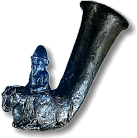
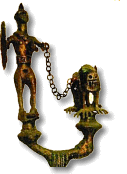
Among the earliest and biggest Urartian towns there was Yerebuni situated on Arin-berd hill (the south-eastern outskirt of what is now Yerevan), a major administrative and econo-mic centre of the northern part of the country. According to the Khorkhor cuneiform record and two other identical re-cords found in the citadel, Yerebuni was built by Argishti I in 782 (this date is considered that of the foundation of Yerevan). In honour of founding the city, a painted wooden figurine of an armed warrior was made, with a cuneiform inscription on a bronze pedestal. This confirms the signif-cance of Yerebuni is an important military stronghold of the country. This s~n~all sculpture is an interesting specimen of Urartu art.
Yerebuni, built after the pattern of Urartu settlements, a rather clear-cut layout. Town neighbourhoods were
lmost immediately following the collapse of Urartu, the tribes in the Armenian plateau reorganized into a new kingdom, the Armen or Arameh. Greek records began calling them Armenians, and their kingdom "Armenya".
The Persian conquest of the Medes (a forerunner tribe of the Kurds), led by the Achaemenid Cyrus the Great, established Persia as a regional power, but it was often contested by the new Armenian kingdom, and constant alliances were required to maintain the Achaemenid borders. Armenians participated in the Persian wars against Greece, and were an important linchpin in Persia’s aspirations to conquer the West.
The Behistun Inscription, carved during the reign of Darius II, record one of the earliest mentions of the Armenians as a distinct nation, using both Urartu and Armenia interchangably in the inscriptions. Records of the Armenian rebellion and the Second babylonian Rebellion, led by and Armenian named Arakha, who called himself the true Nebuchadnezer, give an impression of a resilient nation fully formed.
Local control was held by the Yervandid or Yervandian (Yervanduni) dynasty, into the Hellenistic era. During the reign of king Yervand Sakavakyats (570-560) of the Yervanduni royal house, the brother of the kings wife, Vardkes (Vaghen) Manuk or the youngest greatly rebuild an reshaped the old Araratian city of Quarlini and renamed it in his honor "Vagharshapat"
The Macedonians: Hellenism
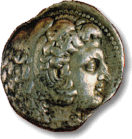
Alexander did not invade Armenia proper, but took control of the state after the fall of Persia. After his sudden death in 323 BCE., the partitioning of his empire and warring among his generals led to the emergence of three Greek kingdoms. Armenia fell under the rule of Seleucis in 311 BCE, but despite pressure from the Seleucids, the Yervandid dynasty continued to control the largest of three kingdoms into which Armenia hCE been divided: Greater Armenia, Lesser Armenia and Sophene. The Seleucid dynasty lasted until the Roman defeat in 189 BCE.
The influence of Hellenism on Armenia was great, and rapidly assimilated. This may be because the Greek culture was influenced by Dorians, Indo Europeans with the same roots as Armenia, which would have found much to identify with in the new Greek culture. Whether that or no, Armenian culture absorbed Greek philosophy, architecture and religion, giving Armenian deities Greek names, and eventually, their human likeness.
Seleucid influence over Armenia ended in the second century BCE with their defeat by the Romans. The Romans allowed the two former Seleucid satraps to set up independent Armenian states. A local general named Artaxias (Artashes) declared himself King of Greater Armenia in 189 BCE with its capital at Artashat, 30 km south of Yerevan.
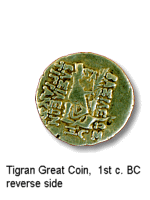
During the reign of Tigran the Great (95-56 BCE), the Armenian empire reached its zenith of military strength and political influence. The empire stretched between the Caspian and Mediterranean Seas, allowing Tigran to proclaim himself "King of Kings."
Vagharshapat was a center for commerce and on
the roCE to the religious center at Yervandakert. Statues and fire temples
were predominant, one still lies underneath the main altar at the cathedral.
Armenia experienced 10 years of peace before Tigran died at the age
of 85, in 56-55 BCE in the capital at Artashat. Further kings ruled
over a country that still controlled the trade routes between Asia and
the West, which was named the Silk Way in the 2nd c. BCE, and which
gave Artashat and Vagharshapat unimagined wealth. In 163 CE the Romans
destroyed Artashat and Vagharhapat, assuming renewed domination over
Armenia.
As Armenia re-asserted its autonomy, the Arshacid tun (princely family), led by Artashes, built a new capital at Kainepolis (present day Echmiadzin) while Roman and Parthian domination continued into the early Christian era, when Armenia became the focus of religious as well as political change in the Western world.
The Sassanids
Tigran's son Vagharshak (193-213) moved the capital to present day Echmiadzin and named it Vagharshavan, while Roman and Parthian fighting continued, using Armenia as a battlefield. The situation became much more critical when Ardashir, a descendant of Sassan, overthrew the Parthian kingdom in 226, and established the neo-Persian empire, with roots based in Zoroastrianism. Vagarshak, a Parthian, was killed in battle against the Sassanids. The destruction of their Parthian kin and the murder of their own king brought a rapprochement between Armenia and Rome.
This was during the reign of Khosrov the great (213-261), who appealed to the Roman Emperor for help. The emperor sent troops from Egypt and Pontus to Armenia, and with them, Khosrov defeated the new Sassanid King Ardashir, forcing their retreat. Ardashir, realizing he could not defeat Khosrov, resorted to espionage. He promised 'if any should arise who can avenge me and assuage my wrath I will award him second place in my realm, inferior only to the monarch himself.' He made peace with the remaining Parthians in his court, promising them, 'you will more easily succeed in this because of your friendship and kinship.' He promised to give any Parthian who killed Khosrov the city of Pahlav and the countries of the Kushan.
A man named Anak, belonging to the Suren branch of the Pahlav family promised to do the deed, whereupon Ardashir is written in the chronicles as saying, 'If you succeed…I shall restore to you the whole country of the Pahlavs, I shall richly reward you…' All those promised they do not intend to keep.
Anak feigned revolt against the Sassanid King and escaped to Khosrov, bringing his family with him. Khosrov received him warmly and sent him to the province of Artaz. Legend has it he accidentally pitches his tent on the spot where the apostle Thaddeus hCE been killed, and that night his wife gave birth to a child, a child who would have the greatest influence on Armenia's history.
Two years elapsed before Anak could act upon his promise. One day, while they were out hunting, he and his friends murdered the king. They fled to Artaz, pursued by Khosrov's army, who hCE managed to live long enough to order the death of Anak's family. This they did, except for the child, who was smuggled out of Armenia by his Christian foster mother to Caesurae, where he was raised.
Ardashir invaded Armenia and slaughtered Khosrov's family. The nobility in Armenia appealed to the Emperor Valerian to intercede, but Ardashir defeated local attempts at resistance before help could arrive. Valerians concluded an agreement with the Sassanids, in which Armenia was divided between Ardashir and the Romans. Ardashir introduced fire-worship and demolished the local temples, including the temple to the sun and moon at Armavir.
Khosrov's son, the young prince T'rdat was smuggled by a close friend of the deCE king, Artavazd Mandakouni, to the safety of Rome.
At the Roman court, T'rdat became a favorite of the Emperor Licinius, his benefactor and protector. As he grew into manhood, his immense, superhuman strength was noticed by contemporary historians.
"He (Trdat) signalised his youth by deeds of valour and displayed matchless dexterity, as well as strength in every martial exercise" (Gibon, The Decline and Fall of the Roman Empire, London 1862).
A description of the prince by 5th century historian Movses Khorenatsi (Moses of Khorene) said "T'rdat was physically so powerful that he could seize two wild bulls by the horns and break the horns of with his bare hands". Another account by Khorenatsi relates leapt off his chariot and stopped both his own and his rivals chariots by sheer strength. Another story told by Armenian and Roman historians relate how Prince T'rdat, single handedly fought off a group of soldiers who sought to assassinate Licinius.
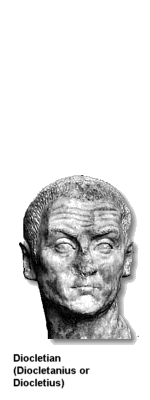
Finally, Agathangelos (4th c. biographer of Trdat III the Great) records that a Gothic chieftain challenged Licinius' successor, Diocletius, to combat. T'rdat stood in the emperor's place and defeated the chieftain. The emperor is said to have been so grateful he gave T'rday an entire army of Roman Legions to regain the throne of Armenia.
Arriving in Caesurae, T'rdat was joined by Armenian nobles (nakharars), including the son of Anak, by legend born on the spot where Thaddeus the Apostle was martyred. T'rdat defeated Shapur, the son of Aradashur, and was appointed king of Armenia in 286-7 AD.
Things quickly began to change in the year 297 AD. T'rdat, having seen the true nature of Diocletanius, who in 297 CE invaded Armenia and conducted and signed a treacherous treaty (behind Trdat's back) with Sassanid Persia, by which a vast amount of territory from Western provinces of Greater Armenia, became "protectorates" of Rome.
The truce with the Sassanid Persians in Nisibis, in 298, enabled Diocletian, Augustus of the Orient, to create five Roman provinces beyond the Tigris, and facilitated a period of relatively peaceful relations between the two empires.
But it did little to protect Armenia. The threat from the Sassanids grew. Playing Rome against Persia, Armenians knew they were in a dangerous game, and as fate would have it (fate always having a say in Armenia's life), events would overtake these worries, create a new one, and begin the identification of the Armenian People.
History 3