 he
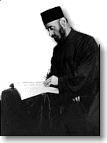
square is named after Komitas (Soghomon Soghomonian,
1869-1936), whose statue (29) lies directly on the north
side. Born in the village of Kiotahia (present day Turkey), Komitas
is considered one of Armenia's cultural icons. A graduate of the Gevorkian
Seminary in Echmiadzin as a specialist in Sacred Music, he spent much
of his time collecting Armenia's folk songs, many of which are direct
descendants of Armenia's pagan era. His efforts had a profound effect
on the European music world, fostering the acceptance of folk music melodies
in classical repertoires.
he
square is named after Komitas (Soghomon Soghomonian,
1869-1936), whose statue (29) lies directly on the north
side. Born in the village of Kiotahia (present day Turkey), Komitas
is considered one of Armenia's cultural icons. A graduate of the Gevorkian
Seminary in Echmiadzin as a specialist in Sacred Music, he spent much
of his time collecting Armenia's folk songs, many of which are direct
descendants of Armenia's pagan era. His efforts had a profound effect
on the European music world, fostering the acceptance of folk music melodies
in classical repertoires.
Komitas efforts to decipher medieval Armenian musical notation is also credited with helping to read Europe's medieval music. Ironically, Komitas research into polyphonic musical notation (that found on ancient manuscripts) helped to decipher Gregorian chant notation, which had its antecedents in Armenian medieval music, reputedly introduced to Pope Gregory by an Armenian monk. By the beginning of the 20th century Komitas believed he had succeeded in cracking the notation code, and was about to make public his research when the genocide ended his career.
On April 17-18, 1915, in an Armenian church in the Ghalatia quarter of Constantinople (Istanbul), he present the premiere of his Patarak (Messiah). The second concert was to scheduled for May 3rd, but on April 24th, along with other Armenian intellectuals in the city, he was arrested and exiled from the city. En route he witnessed the genocide first hand, and the horror drove him insane. Because of the intercession of influential Turkish and foreign authorities, he was brought back to Constantinople, but it was too late. The remaining years of his life were spent until 1919 in the military hospital in Constantinople, and then in the Hospital for the Insane in Paris, where he died in 1936. In the same year his ashes were transferred to Yerevan, where they were interred at the newly created Komitas Pantheon.
Komitas' unraveling of the medieval code was lost with his sanity, and it is only recently that researchers believe they have succeeded in deciphering the notation. It should be noted that current musical notation of Armenian medieval music is still considered imperfect without this code. Komitas is venerated by Armenians worldwide, and his repertoire of both sacred and folk music is a hallmark of Armenia's and Europe's music traditions.
Unfortunately the museum space dedicated to his life and work has been usurped by the seminary, but a few items are on display at the Old Residence museum inside the cathedral complex.
To continue the tour, cross the western side of the square (left as you face the statue), where the M'her Abeghian Museum and gallery is located.
KOMITAS SQUARE
Models on the Square (27,28,46,49) Located on the sidewalk around H’raperak are thirteen architectural models of medieval Armenian churches, which give a good overview of the development of church architecture beginning with the 301-303 Cathedral, and Khorvirab Sb. Grigor Lousavoritch.