|
| Shrouded
in myth, the rediscovery of the Armenian alphabet is credited
to Mesrop Mashtots, who, under the patronage of King Vramshapour
and the Catolicos Sahak Parthev (387-428 AD), traveled to
the great centers of learning in Asia Minor before "receiving
a vision where Christ struck the alphabet on stone" |
From its inception, the Armenian Church was allied with the
Greek Orthodox faith, the center of Christianity in that time.
Using Syrian and Greek texts for the scriptures, Armenian services
were far removed from the language of the local population.
In addition, there was dissent between the Armenian Church and
the Greek patriarch around the interpretation of the divine
nature of Christ was he both man and God, or divine spirit alone?
Struggling with the Sassanid Persian Empire, the Armenian kingdom
was also wary of Roman designs, and felt far removed from the
doctrinal debates that were held in Caesura and Greece. These
debates affected the entire structure of doctrinal supremacy,
which led to several schisms between branches of the church
over the next centuries, but that between the Armenian Church
and the Greek Orthodox church was one of the earliest.
While the struggle
between Christianity and paganism continued, to the east of
the kingdom a new crisis arose. The Sassanids began to make
inroads into the Armenian kingdom, bringing with them the Zoroastrian
religion (which was based on the worship of sun and fire). Armenian
paganism revolved around worship of the sun, even in Greco-Roman
times, the favored gods and goddesses were connected to the
sun, the ultimate fire symbol and giver of life. The peasant
class long alienated by the ruling class use of Greek, Persian
and Latin, were not that far removed from their pagan roots,
and would have found an attractive alternative in the Zoroastrian
beliefs.
King Arshak II
(345-367 AD) formed an alliance with the Roman Emperor Julian
in an attempt to stay the invasion by the Sassanids. Neither
Julian nor his successor, Valens, complied with this pact, using
the failure of the Armenian Church to recognize the Roman Oriental
Church as a pretext. The Armenians were thus forced to come
to terms with the Sassanid Persians who, in turn, refused to
recognize them in negotiation. Among the many decisions aimed
at limiting the influence of the Armenian Church made by the
successor of Arshak II, Pap (368-374 AD), one in particular
put an end to the tradition of the ordination of the Armenian
Catolicos in Caesura, distancing the Armenian Church from Greek
influence.
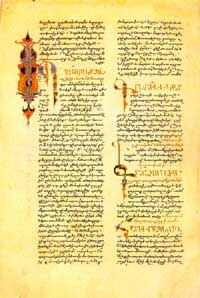 The
Armenian Arshakid kingdom was subdivided in 387 by an agreement
between the Roman emperor Theodosius and the Sassanid King Shapur
Ill, to the clear advantage of the Sassanids, who were assigned
four-fifths of the territory. Nevertheless the two segments
of the former Armenian kingdom always remained in contact, thanks
to their common faith. In order to preserve the Armenian culture
and protect the royal house, the Armenian king Vramshapour and
the Catolicos Sahak Parthev (387-428 AD), undertook to ‘create’
a new Armenian alphabet. An alphabet would guarantee the influence
of the Church over the entire people, avoiding the need to filter
passages from the Sacred Scripture (written in Syrian or in
Greek) during the mass by means of oral repetition by figures
known as 'translators'. The
Armenian Arshakid kingdom was subdivided in 387 by an agreement
between the Roman emperor Theodosius and the Sassanid King Shapur
Ill, to the clear advantage of the Sassanids, who were assigned
four-fifths of the territory. Nevertheless the two segments
of the former Armenian kingdom always remained in contact, thanks
to their common faith. In order to preserve the Armenian culture
and protect the royal house, the Armenian king Vramshapour and
the Catolicos Sahak Parthev (387-428 AD), undertook to ‘create’
a new Armenian alphabet. An alphabet would guarantee the influence
of the Church over the entire people, avoiding the need to filter
passages from the Sacred Scripture (written in Syrian or in
Greek) during the mass by means of oral repetition by figures
known as 'translators'.
An Armenian alphabet
was one of the key components of preserving Armenian identity
in the face of Sassanid incursions and those that followed.
Shrouded in myth, the rediscovery of the Armenian alphabet is
credited to Mesrop Mashtots, who, under the patronage of King
Vramshapour and the Catolicos Sahak Parthev (387-428 AD), traveled
to the great centers of learning in Asia Minor before "receiving
a vision where Christ struck the alphabet on stone".
Legend has it
that the hermit monk Mesrop Mashtots created the alphabet through
divine inspiration in 401-406 AD. A pupil of Mashtots, Koriun,
in his history of the Armenian Alphabet adds fuel to the controversy
by carefully avoiding giving total credit to Mashtots for creating
a script. In fact, Koriun avoids using the word "creation" or
"invention" anywhere in his account, referring to Mashtots as
a ‘translator’ who was "looking for a thing" that was "found"
in Edessa when Mashtots had his vision.
As the crisis
with the Sassanids and the Roman empire deepened, it is conjectured
that Mashtots who was the personal translator to the king was
dispatched to uncover the older version of Armenian which Gregory’s
campaign against paganism had destroyed. More than one hundred
years had elapsed since Gregory began his campaign to convert
the country, and no traces of any native Armenian script remained
in the kingdom.
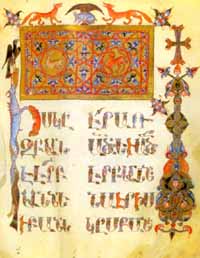 With
his pupils Mashtots traveled throughout Asia Minor to "find
the thing you are looking for". They began at the kingdom of
Goghtu (present-day Nakhichevan), which had not yet converted
to Christianity, and was thought likely to have the older text.
Failing there, they traveled to Edessa, where he was told that
there was an old scholar ‘who has the thing you are looking
for’, but that he converted to Christianity and now lived in
Samusart. In Koriun’s text, at Samusart Mashtots found "the
thing he was looking for,’ and that night he had a vision where
the right hand of Jesus struck the letters of the alphabet on
stone. Mashtots and his entourage triumphantly returned to Armenia,
greeted by the king and Catolicos and pronounced savior of the
Armenian people. With
his pupils Mashtots traveled throughout Asia Minor to "find
the thing you are looking for". They began at the kingdom of
Goghtu (present-day Nakhichevan), which had not yet converted
to Christianity, and was thought likely to have the older text.
Failing there, they traveled to Edessa, where he was told that
there was an old scholar ‘who has the thing you are looking
for’, but that he converted to Christianity and now lived in
Samusart. In Koriun’s text, at Samusart Mashtots found "the
thing he was looking for,’ and that night he had a vision where
the right hand of Jesus struck the letters of the alphabet on
stone. Mashtots and his entourage triumphantly returned to Armenia,
greeted by the king and Catolicos and pronounced savior of the
Armenian people.
Since there are
no stones in Samusart like that described in Koriun’s text,
historians believe that the ‘thing’ Mashtots was looking for
was a sample of old Armenian script, the Haikasian Script. Travelling
through the Sinai, he would have seen examples of the Odessian
Script, and linked it to the Haikasian Script. With these two
examples, he was able to reconstruct the alphabet, making a
few alterations in the design.
This conjecture
is by no means universally accepted, it is constantly under
vehement debate. To some, any questioning of the divine inspiration
of the Mesropian Script is a heresy. To others, it is merely
speaking historical fact. To many, it illustrates the inscrutable
aspect of inspiration: who can say that God didn’t speak to
Mashtots, leading him to earlier scripts and striking the new
form for him in his dream?
However it happened,
the introduction of the alphabet allowed the Armenians to create
distinct identity in the face of surrounding enemies, and for
the Armenian church to translate the scriptures into written
Armenian, leading to its separation from the influence of the
Greek Orthodox (and Byzantium) influence. The Armenian’s were
suddenly a nation as well as a cultured people, and a flowering
of written culture appeared in the country, the most stunning
examples of which are the tens of thousands of manuscripts which
have been preserved to this day. Works of art, these manuscripts
were often embellished with gold and rare color, and they fostered
a period of scientific and philosophic learning which gave rise
to Europe’s Renaissance.
|