First and Second Republics
Freedom gained, lost, reinvented
Tour Armenia
A New World Order
Russia took Ottoman Armenia in 1916, reuniting the two lands for the first time since the 16th century. Thousands of Armenian immigrants from Turkish controlled Armenia poured into the newly freed East, many dying of starvation or drowning in rivers as they ran from charging Turkish soldiers, who were repelled by Russian troops at the border. In 1917 America entered the war, and German resistance slowly crumbled. When Allied troops landed in Turkey in 1917, the Ottoman Empire fell, but the Young Turk government took up the reigns, and resumed its quest to create a pan-Turkish Empire that would stretch across the Caucasus into Central Asia.
In November of 1917, the Russian Revolution toppled the Czar, with first the Mensheviks, then after the November Revolution, the Bolsheviks under the leadership of Lenin, assuming control of the government. The Russian forces began to withdraw from lands they occupied in Ottoman territory.
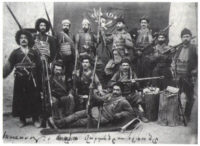
Andranik believed that the Russians still held the key to saving Armenia from annihilation. He sent Lenin a telegram from Tbilisi, offering 5000 soldiers under his command. Implied in his telegram was the threat of the Turks, and Andranik wanted support from the new Russian government to continue his fight against them. Lenin declined the offer, and attacks against Dilijan prompted Andranik to march there. Meanwhile an assembly was held in Yerevan to form a new government, led by the Dashnaks.
By 1918 Lenin, desperately needing access to the Caspian Sea oilfields, focussed attention on the area around Baku, and withdrew final Russian troops from occupied Turkish lands in Western Armenia, sending Stepan Shahumian to Baku to wrest control from British forces there. Shahumian and his followers succeeded in taking control of the city, reportedly killing hundreds (Azeri's say thousands) of resistors, establishing a Socialist government. Because Lenin was unable to send him military support, his government soon fell, replaced by a new one that declared independence. Shahumian and his followers were deported into the desert in what is now Turkmenistan and on September 18, 1918 they were shot. Meanwhile the Turkish army in the West began attacks against Armenia, while Turkish forces in present-day Azerbaijan (called Musafatists) began to attack from the East and North, joining forces with Menshevik armies in Tbilisi.
Sardarabat and Independence
 A short respite from fighting occurred when the nations of the Caucasus declared themselves a federation independent of Moscow on 22 April 1918, but ethnic and religious differences caused a split between the countries. Precipitated by massacres against Armenians in Baku in April and May, and a concerted effort by Turks to once and for all destroy the Armenians by smashing through the new republic to create a pan-Turkish empire stretching to Central Asia, the combined Menshevik and Musafatist forces attacked Armenia from the North and East, moving into Lori and Zangezur, while Turkish forces attacked from the West. Andranik and Garegin Nezhdeh were entrenched in battle in Zangezur, but the Western border seemed hopelessly vulnerable. A short respite from fighting occurred when the nations of the Caucasus declared themselves a federation independent of Moscow on 22 April 1918, but ethnic and religious differences caused a split between the countries. Precipitated by massacres against Armenians in Baku in April and May, and a concerted effort by Turks to once and for all destroy the Armenians by smashing through the new republic to create a pan-Turkish empire stretching to Central Asia, the combined Menshevik and Musafatist forces attacked Armenia from the North and East, moving into Lori and Zangezur, while Turkish forces attacked from the West. Andranik and Garegin Nezhdeh were entrenched in battle in Zangezur, but the Western border seemed hopelessly vulnerable.
The Turks were at first successful, sweeping past Kars and Ardahan, retaking the territories West of the Arax River (the border between Eastern and Western Armenia). When the city of Alexandropol (Giumri) surrendered on May 15, 1918, the Turkish victory seemed imminent, and Turks invaded the Ararat valley occupying the village of Sardarabat and railway station on May 21. On May 22 an attack was begun in the direction of Yerevan, which would have toppled Armenian resistance.
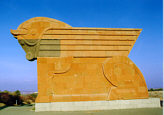
Sardarabat was the decisive battle of the struggle against the Turkish threat. Led by Daniel-Bek Pirumian, Armenian troops moved to the left bank of the Arax River. Civilians came out by the thousands to stand by the Armenian army, among them Kurds, Greeks and Russians (including units of the former Russian Caucasian Army). For six days church bells rang throughout the country, calling people to aid. Old and young alike came forward, armed with clubs, pitchforks and rocks, they stood down an army of overwhelming odds, and the Turks fled in panic. The Turkish army regrouped, and over the next 3 days each advance was repelled until on May 24 the Armenians took the offense and completely routed the Turkish regular army.
The victory at Sardarabat, followed by others at Bash-Aparan and Gharakilisa (May 24-28) led to independence on May 28, 1918, when the first Republic of Armenia was established, along with the Republics of Georgia and Azerbaijan. The territories of Nakhichevan and Nagorno Karabakh--historically inhabited by Armenians--were part of the Armenian Republic, and protected by Armenian and Russian soldiers during much of the Russian Civil War.
 The Bolsheviks The Bolsheviks
The Republic was short-lived, though, the government facing overwhelming difficulties in constructing a new country. The threat from Turkey continued, eerily foreshadowing the virtual blockade against Armenia in force today. As the tide of the Russian Civil War turned in favor of the Red Army, Lenin drew up plans to retake the Czarist Russian Empire, including the Caucasus regions. Menshevik and Musafatist armies continued fighting Armenia, until the Armenian army, led by D'rostamat Kananian ("D'ro") repelled invasions in the North and entered Georgia, moving as far as the edge of Tbilisi. A truce was declared on New Year's Eve, 1919, and the Armenian Army withdrew.
Andranik left Armenia following the 1918 Batumi Agreement, which denied the territories of Zangezur and Nagorno Karabakh from Armenia, as well as Armenian lands taken in Turkey. Feeling the politicians had betrayed the Armenian cause he refused to honor the agreements, and exiled himself to Paris.
The Red Army invaded Armenia in April of 1920, through Kirovabad. Pressure exerted simultaneously by the Turks and Communists forced the collapse of the republic in 1920. Alexander Miasnikian declared Armenia part of the Transcaucasian Soviet Federated Socialist Republic on November 29, 1920.
The Zangezur War
 Beginning in 1921, Lenin made overtures to the new Turkish government, led by Ataturk, which was under siege by Greek forces attempting to retake their historic lands. Having been promised the return of Asia Minor by the Allies for their support during World War I, when the Allies reneged on the deal, they had invaded, landing troops at Smyrna in May of 1919. By 1921 they were on the edge of Ankara. Beginning in 1921, Lenin made overtures to the new Turkish government, led by Ataturk, which was under siege by Greek forces attempting to retake their historic lands. Having been promised the return of Asia Minor by the Allies for their support during World War I, when the Allies reneged on the deal, they had invaded, landing troops at Smyrna in May of 1919. By 1921 they were on the edge of Ankara.
Correspondence between Lenin and Trotsky in 1920-21 show that they believed the next field for expanding socialism was in Asia, and they began spreading dissent in the region. Secret letters between Lenin and Ataturk show that the new Communist State promised funds and soldiers to the Turkish government in return for favorable relationships. It is no coincidence that Ataturk approved the current flag of Turkey at that time, looking very much like a variation of the Soviet red Banner. Lenin insisted on officially keeping the Armenian lands of Kars, Van and Erzerum ceded from Turkey at the end of the war, but he promised Ataturk that the Armenian territories of Nagorno Karabakh, Nakhichevan, Zangezur and Siunik would revert to the new Azerbaijan Republic. Further, he sent more than 24 million dollars, guns and ammunition to the Turkish forces, enabling them to repel Greek advances, and to kill the local Greek population. Turkey continued to set its eyes on a pan Turkish Empire, building up forces yet again to invade Armenia.
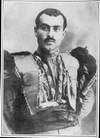 One man stood in the way of Ataturk's and Lenin's plans. Led by Garegin Nezhdeh, local Armenians fought against both Turkish and Red Army forces at the same time, creating a standoff in Siunik and Zangezur. Nezhdeh used Andranik's tactics for guerilla war, cutting off troops in mountain passes and defeating them in small numbers. With only a few hundred men, he managed to defeat repeated incursions by far greater forces. One man stood in the way of Ataturk's and Lenin's plans. Led by Garegin Nezhdeh, local Armenians fought against both Turkish and Red Army forces at the same time, creating a standoff in Siunik and Zangezur. Nezhdeh used Andranik's tactics for guerilla war, cutting off troops in mountain passes and defeating them in small numbers. With only a few hundred men, he managed to defeat repeated incursions by far greater forces.
The situation quickly grew to a stalemate, as Lenin gradually understood that Ataturk had no intention of building a socialist state, and that the Red army could not defeat Nezhdeh. Not daring to expose the Southern regions to Turkish invasion, Lenin chose to compromise, agreeing to Nezhdeh's terms. Alexander Miasnikian, the first Commissar of Armenia, sent a telegram to Nezhdeh, guaranteeing the inclusion of Siunik and Zangezur in the Armenian State. Nezhdeh left for Bulgaria, and then settled in Paris, having preserved at least one part of the Armenian lands.

 Top
Top

|