Soviet Armenia
Lenin, Stalin, Khruschev, Brezhnev, Geriatrics and revival
Tour Armenia
A SOCIALIST HOMELAND THE GREAT PURGE WORLD WAR II A NEW ERA
A Socialist Homeland
The history of Armenia in Soviet times is a recent memory, and as such, it is often neglected as Armenians build their new republic. For many it is too painful a memory, for others it is anathema to suggest anything positive happened at all. But the events of this period were significant, for they led to the present democracy with all its triumphs and difficulties.
Between 1921 and 1924, Armenia witnessed a resurgence of intellectual and cultural life as it began to build a socialist state under the leadership of Miasnikian. This was also the period of the New Economic Policy, in which Lenin permitted limited private business on the local level. Repression against dissent was coupled with the arrival of Armenian intellectuals, writers and artists who believed they had at last a homeland. The writers Isahakian, Toumanian, Charents, artists Martiros Sarian, Teremezian and the noted scientist Orbeli were among the cultural leaders who immigrated during this time. The architect Alexander Tamanian, who had begun a central plan for the new capital of Yerevan during the first Republic, returned and completed his plans. He designed a city for the then unheard of population of 150,000, with a central square, planned neighborhoods, massive buildings and parks. He also included a green belt around the city, one of the first of the modern age. Yerevan State University, also planned during the first Republic, was constructed, staffed with professors recruited from the West.
By 1923, Stalin had become Commissar for Nationalities, and he placed Karabakh and Nakhichevan with their 80% Armenian population, within Azerbaijan. By carving smaller pockets of Azerbaijani and Armenian communities from opposite, Stalin established a type of Grand Chess Game, insuring ethnic tension between the distinct groups would keep them from uniting against his own power. The treaty ceding Kars, Erzurum and Van back to Armenia was never honored, Stalin choosing not to demand them when he succeeded Lenin.
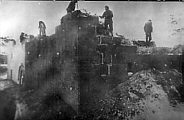 On January 5, 1924, Lenin died, and Stalin began to assume power. Miasnikian died in the same year, after a tumultuous relationship with Moscow where he consistently put the fate of Armenians in Turkish controlled lands before Stalin who, legend has it, ordered him killed by poison. Miasnikian was replaced by Aghasi Khandjian, who continued to press Stalin on the Armenian issue while pushing development of the country. More Armenians immigrated to build the new country, among them the composer Spendiariov, historians N. Mara and Leo, writers H. Hovhanian and Vahan Teghian, the linguist Hratchia Ajarian and actors Petros Adamian and Vahan Papazian. On January 5, 1924, Lenin died, and Stalin began to assume power. Miasnikian died in the same year, after a tumultuous relationship with Moscow where he consistently put the fate of Armenians in Turkish controlled lands before Stalin who, legend has it, ordered him killed by poison. Miasnikian was replaced by Aghasi Khandjian, who continued to press Stalin on the Armenian issue while pushing development of the country. More Armenians immigrated to build the new country, among them the composer Spendiariov, historians N. Mara and Leo, writers H. Hovhanian and Vahan Teghian, the linguist Hratchia Ajarian and actors Petros Adamian and Vahan Papazian.
The growth was impressive. From an agriculturally based economy, Armenia began to transform into an industrial country. Tamanian's plans were realized, as the Opera House opened, followed by theatres and concert halls, and the completion of Republic Square with the National History Museum Building. But much of Armenia's architectural development was limited to Yerevan, Armenia's contribution to the Soviet economy mostly limited to exporting minerals and workers to Russia. When Stalin had Trotsky expelled in 1927, he took open control of the Soviet State, ending the New Economic Policy, and forcing collectivization of farms and private enterprises. The collectivization of the farms was disastrous through the Soviet Union, many of those who resisted being killed. No figures exist for Armenia, but the resistance by farmers, who had become very rich under the New Economic Policy, was fierce, and repression was harsh.
The Purge
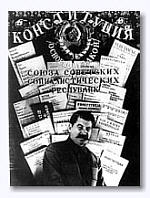 In Georgia, Stalin eliminated more than 100,000 opponents by sending them to Siberia. Many were Armenians, and perhaps as many were exiled from Armenia before the beginning of the great purges in the 1930s. The 1932-33 drought, coupled with refusal of farmers to give their cattle to the state, killing them instead, prompted mass starvation, with as many as 20 million dying of starvation in Ukraine, Belarus and Russia. There was starvation in Armenia, but it is believed more people died through repression, though the numbers have never been published. Religious persecution begun under Lenin increased during the reign of Stalin, with churches, seminaries and monasteries shut down, their lands forfeit to the state. Clergy were shot or deported to Siberia, and the Holy Seat at Echmiadzin faced increasing harassment. In Georgia, Stalin eliminated more than 100,000 opponents by sending them to Siberia. Many were Armenians, and perhaps as many were exiled from Armenia before the beginning of the great purges in the 1930s. The 1932-33 drought, coupled with refusal of farmers to give their cattle to the state, killing them instead, prompted mass starvation, with as many as 20 million dying of starvation in Ukraine, Belarus and Russia. There was starvation in Armenia, but it is believed more people died through repression, though the numbers have never been published. Religious persecution begun under Lenin increased during the reign of Stalin, with churches, seminaries and monasteries shut down, their lands forfeit to the state. Clergy were shot or deported to Siberia, and the Holy Seat at Echmiadzin faced increasing harassment.
The Stalinist Purge of 1934-1939 was the most severe, with 100,000 intellectuals and political leaders disappearing in 1934 alone. The repression in Armenia began in 1936, when Stalin's lieutenant and head of the NVKD, Lavrenti Beria, called Khandjian to Tbilisi on the pretext of a meeting and killed him. The entire party apparatus was eliminated in Armenia as well as most of the intellectual class, accused of bourgeois nationalism. Yeghegis Charents, Axel Bakuntz, Alazan, NVD Minister Mughdusi, Giurgen Mahari were among the thousands eliminated in the purges, as well as virtually the entire teaching class. Throughout 1937 and 1938, the NKVD's 'black raven' vans continued to silently collect victims at night, most of which were never heard of again. By 1939 it is thought that eight and a half million people were killed or sent to the gulags in Siberia, where 90% died of starvation, exposure and abuse. At least 100,000 Armenians were victims of the purge.
World War II
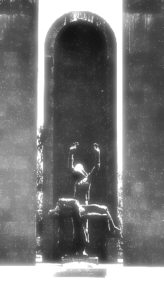 On September 1, 1939, Germany invaded Poland, and on September 3 England and France declared war on Germany. When the Germans invaded the Ukraine, Belarus and Russia in June of 1941, they moved almost to Moscow before an early winter stopped them. During the war, the German Army fought ferocious battles with the Red Army around Stalingrad in an attempt to reach the Caucasus Oil and mineral fields. Armenians distinguished themselves in fighting, 105 becoming Heroes of the Great War, more than any other republic. There is not a village or town in the Republic without a monument to the soldiers who fell during the “Great Patriotic War”. Armenians distinguished themselves as commanders in the field, with Marshalls Baghramian (who as a 20 year old fought the Turks at Sadarabat), Babajanian, Khudiakov Khambertian, Nakhimov and Admiral Isahakov. Of a population of just 2 million, 630,000 Armenian men and women fought in the war. Of those, 315,000 died. On September 1, 1939, Germany invaded Poland, and on September 3 England and France declared war on Germany. When the Germans invaded the Ukraine, Belarus and Russia in June of 1941, they moved almost to Moscow before an early winter stopped them. During the war, the German Army fought ferocious battles with the Red Army around Stalingrad in an attempt to reach the Caucasus Oil and mineral fields. Armenians distinguished themselves in fighting, 105 becoming Heroes of the Great War, more than any other republic. There is not a village or town in the Republic without a monument to the soldiers who fell during the “Great Patriotic War”. Armenians distinguished themselves as commanders in the field, with Marshalls Baghramian (who as a 20 year old fought the Turks at Sadarabat), Babajanian, Khudiakov Khambertian, Nakhimov and Admiral Isahakov. Of a population of just 2 million, 630,000 Armenian men and women fought in the war. Of those, 315,000 died.
Armenia experienced fantastic growth following World War II, propelled by rapid development of technology, and the influx of Armenian immigrants, lured by a relaxation of repression and appeals to the Diaspora to rebuild their homeland. The immigrants found themselves trapped in a Stalinist state, and most had returned by the 1960's. But they did build a new country, as schools, factories and homes rose at an incredible rate. Yerevan was transformed, growing from around 50,000 to 1.3 million, almost half of the Republic’s population in 1989. The Academy of Science was formed in 1945, and increasing importance on Armenians in the sciences became apparent throughout the Soviet Union. Huge factories and chemical plants were erected in Yerevan, Giumri and Kirovakan (Vanadzor), and an intense reclamation of the Ararat valley began, with mammoth irrigation and reservoir systems. The intense use of the Sevan Lake waters to electrify the country and irrigate the country led to significant economic growth, but it also caused one of the major ecological problems facing the country.
A New Era
 In 1947, new repression began in the Soviet Union, with the majority being exiled to new industrial complexes in Siberia. Stalin died in 1953, and a committee ruled in his stead before Nikita Krushev assumed control of the Communist party. Krushev instituted an unparalleled period of development in agriculture and technology, and the growth in Armenia was explosive. The "Krushev Thaw" followed the 23rd Assembly in 1956, where he outlined Stalin's crimes, and brought about the release of some prisoners in the gulags and limited freedoms in intellectual life. To a person, Armenians consider the Krushev period the best of the Soviet Era. The growth of urban areas was explosive, with Kadjaran, Charentsavan, Abovian, Hrazdan, Kamo (Gavar), Martuni, Vardenis, Kapan, Giumri, Kirovakan (Vanadzor), and Ijevan seeming to become cities overnight. This was also the era of the "Krushev Shenk" (Krushev Building), cookie cutter constructions that housed thousands of people in new homes, but were poorly designed and built. In 1947, new repression began in the Soviet Union, with the majority being exiled to new industrial complexes in Siberia. Stalin died in 1953, and a committee ruled in his stead before Nikita Krushev assumed control of the Communist party. Krushev instituted an unparalleled period of development in agriculture and technology, and the growth in Armenia was explosive. The "Krushev Thaw" followed the 23rd Assembly in 1956, where he outlined Stalin's crimes, and brought about the release of some prisoners in the gulags and limited freedoms in intellectual life. To a person, Armenians consider the Krushev period the best of the Soviet Era. The growth of urban areas was explosive, with Kadjaran, Charentsavan, Abovian, Hrazdan, Kamo (Gavar), Martuni, Vardenis, Kapan, Giumri, Kirovakan (Vanadzor), and Ijevan seeming to become cities overnight. This was also the era of the "Krushev Shenk" (Krushev Building), cookie cutter constructions that housed thousands of people in new homes, but were poorly designed and built.
Another of the achievements of Soviet Armenia was the survival of the church and its ability to stave off more brutal repression faced in other Republics. Armenians are proud of the fact that though seminaries and churches were shut down, the church as a whole survived, and a Catolicos continued to reign in Echmiadzin. Much of this was due to Soviet designs to foment influence in the Middle East, where many Diaspora Armenians lived. By seeming tolerant of Armenian religion, the Soviets hoped to win Armenian converts abroad. Vazgen I (Catolicos from 1954-1994) is credited with maintaining a careful balance between religious practice in the country and the realities of working in a Communist state, permitting a level of religious freedom in the Armenia unknown in the other republics. At the same time, Communists actively discouraged religious practice, and the largest portion of the population--though still thinking of themselves as Christians, Armenians gradually separated from its doctrines and services.
When Brezhnev took control of the Soviet Union in 1964, he appointed Kochinian as First Secretary for Armenia. An amnesty for criminals was followed by repression against the growing dissident movement, which included the use of committing victims to insane asylums. At the same time, the growth experienced under Krushev continued through the 1960's, and recognition of the Armenian genocide was commemorated with the erection of the Tsitsinakaberd monument in 1968. The 60's are also marked by the development of schools and hospitals in rural areas. At the same time Armenian scientists, economists and politicians were taking an increasing role in the running of eh Soviet Union.
By the 1970’s the Republic of Armenia had achieved under Communist rule an unprecedented level of development, and was the richest republic per capita in the Soviet Union. Soviet Armenians--like Soviet Jews-- were responsible for large parts of the economy and technical achievements of the empire. Armenians distinguished themselves in the sciences, arts and engineering, appearing the in Soviet Who’s Who for almost everything. Armenians designed communication and docking systems for the Cosmonaut program, they were principally responsible for missile guidance systems, they were discoverers of new origins of the universe and classes of galaxies, and they were extremely valuable mathematicians, physicists and aviation leaders (the Mig jet was designed by Migoyan, an Armenian).
 Armenians were pioneers in communication and computer applications. Despite their lack of access to Western computer technology Armenians were--and are-- some of the most sophisticated programmers and developers of new software. Many learned by secreting in western computers, dismantling and then rebuilding them to learn how they worked. In the process, they succeeded in correcting errors in the original designs. Armenian archeologists and historians uncovered countless finds that have changed the classical view of the origins of civilization. Armenians were pioneers in communication and computer applications. Despite their lack of access to Western computer technology Armenians were--and are-- some of the most sophisticated programmers and developers of new software. Many learned by secreting in western computers, dismantling and then rebuilding them to learn how they worked. In the process, they succeeded in correcting errors in the original designs. Armenian archeologists and historians uncovered countless finds that have changed the classical view of the origins of civilization.
When Demirchian became First Secretary of Armenia in 1974, the final growth spurt of the country began. Within 3 years Yerevan grew to one million people, fed by development of new housing at Massif, Davetashen and "Bangladesh".
Brezhnev was followed by the geriatric Andropov and Chernenko, then Mikhael Gorbachev in April of 1985. Demirjian was replaced as First Secretary by Suren Haroutnunian in 1988, then by Vladimir Movsisian in 1989.

 Top
Top

|