|
We know of the monastic universities and cultural centers in Medieval
Armenia through the manuscripts themselves and the comments written
by scribes in their margins. Sadly, we know of these centers through
descriptions of how they were destroyed by invaders.
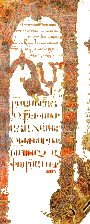 One
scribe wrote: "Tamerlane gave an order to seize and destroy
a vast number of ancient manuscripts, some of which he carried
away to Samarkand." One
scribe wrote: "Tamerlane gave an order to seize and destroy
a vast number of ancient manuscripts, some of which he carried
away to Samarkand."
"In 1179, a library
with ten thousand manuscripts was burnt to the ground in the
city of Baghaberd by invading Seljuks" another writes.
In 1386, the scribe
Hakop described the ordeal endured both by him and his teacher,
the philosopher Hovhan Vortnetsi, during the Mongolian invasion:
"This manuscript was finished in a bitter sorrowful year"
Invading Mongols
captured the Vorotan Fortress, and Vorotnetsi was forced to
flee. The scribe Hakop continues. "And I followed him, heavily
burdened by a bag containing papers and a copy of the manuscript,
ink and pen, reading and writing as much as I could amidst many
difficulties and hardships, for whenever I began writing I couldn’t
finish"
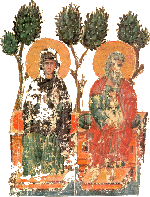
On the last page
there is a drawing which has no relation whatsoever to the subject
of the manuscript. An old man wearing a purple mantle is lying
on the floor with blood flowing from his chest. Blood stained
swords and spears lie by his side. Under the picture is the
young scribe’s memorial inscription in which he asks the reader
"to remember and pray for my spiritual father and teacher slain
by foreign invaders before my very eyes."
 The
letters are stained with tears and the handwriting is jerky.
He continues: "In the last pages of the book there are many
errors, and the letters are large and uneven. This is because
sorrow is profound and I am the most unworthy of my master’s
pupils." The
letters are stained with tears and the handwriting is jerky.
He continues: "In the last pages of the book there are many
errors, and the letters are large and uneven. This is because
sorrow is profound and I am the most unworthy of my master’s
pupils."
The first line of
defense against invaders, many were killed in their cells as
they worked, or had to wander for years to foreign countries
to try and buy back captured manuscripts. Others were cheated
out of promised remuneration a plot of land or an ox and dismissed
from the monastery, penniless.
So prized were Armenian
manuscripts, invaders went to extremes to obtain them. In one
case, when a Persian Shah seized one, he put the offending manuscript
in chains.
During the Mongol
invasion, manuscripts from the Sanahin and Haghbat monasteries
were hidden in gorges and caves in Lori. To make them reveal
their hiding place, the Mongols tortured the monks, during which
three senior and twelve junior clergymen are reported to have
retorted with a line from the Gospel: "Give not that which is
holy unto the dogs, neither cast ye your pearls before swine."
 This
incident was not unique in Armenian history. Through the genocide
when two starving Armenian refugee women saved the Homilies
of Mush, the largest manuscript created, by carrying it
on their backs through hostile territory, burying half in Erzerum
in order to save part of the priceless treasure (the other half
was found and returned to the Matenadaran by a Polish officer
in the Russian army) through all of Armenia’s manuscript history,
scribes and clergy, peasants and simple folk revered the font
of their culture through the care and reverence for their writings. This
incident was not unique in Armenian history. Through the genocide
when two starving Armenian refugee women saved the Homilies
of Mush, the largest manuscript created, by carrying it
on their backs through hostile territory, burying half in Erzerum
in order to save part of the priceless treasure (the other half
was found and returned to the Matenadaran by a Polish officer
in the Russian army) through all of Armenia’s manuscript history,
scribes and clergy, peasants and simple folk revered the font
of their culture through the care and reverence for their writings.
The treasure was
not in the gilt bindings, or the beautifully painted illustrations.
It was not in the expensive inks and liquid gold used to adorn
the books these were but symbols of something deeper in the
Armenian culture. The treasure was in the effort to create substance
from inspiration. It was the intangible made present by words.
In our times, words are taken for granted, they are functional
tools. But to the people who struggled to copy books, to explore
the universe through manuscripts, to those who preserved them,
and saved them from destruction, they were nothing less than
the spirit made flesh, then inspiration and understanding made
tangible on earth. They were a gift from God, and they were
Armenia’s legacy.
|