|
Vaspurikan was a province of Armenia proper, which extended
to the Northeast and south of Lake Van. From ca. 5000 BC
this area was occupied by one of the most ancient civilisations
in the Middle East, and it was here that the state of Armenia
was founded. In the early Middle Ages Vaspurikan was a principality
of Greater Armenia, but in the ninth-eleventh centuries it
became an independent kingdom ruled by the Artsruni dynasty.
The artists working in these secluded monasteries usually
had a modest, non-aristocratic background, and their art was
inspired by and adapted to the tastes of the common people.
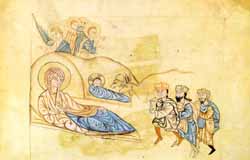
The
Nativity
The Gospels
1319/20, town of Artskeh, Vaspurikan
Written and illuminated by Vardan |
|
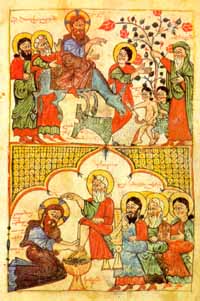
The Entry Into Jerusalem; Christ Washing the Disciples
Feet
The Gospels
1392, town of Khizan, Vaspurikan
Written by Petros, illuminated by Hovhannes Khizanetsi
|
|
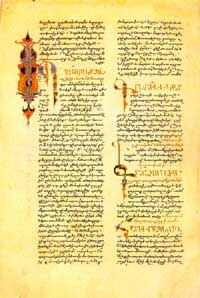
Page from the Bible
1390-1400, town of Khizan, Vaspurikan
Written by Petros, Hovhannes and Melchized, illuminateed
by Hovhannes Khizanetsi
|
The Vaspurikan School
was one of the most prolific in Armenia. Its legacy now amounts
to almost 1,500 manuscripts, the majority of which are illustrated.
Among the distinctive features of Vaspurikan book illustration
is that they often combine miniatures on traditional Gospel
subjects with those based on the Old Testament and the Apocrypha.
Old Testament subjects usually come first and sometimes contain
details suggested by real-life observations. The Christian motifs
in these miniatures are often interspersed with vestiges of
pagan pantheism. The subjects most popular with the Vaspurikan
artists were The Genesis, The Sacrifice of Isaac, The Trinity
(Visitation under the Oak-Tree at Mamreh) and others.
The lack of perspective
in the composition and drawing, typical of medieval art in general,
is more conspicuous in the Vaspurikan miniatures than elsewhere.
Works by Vaspurikan artists are distinguished by a traditional
disregard of the optical approach and by a two-dimensional,
frieze-like representation of scenes in which figures and objects
fill the entire surface of the picture. The figures are usually
presented in a frontal view, and their energetic gestures are
so expressive that they seem to combine several movements in
one. They also tended to replace realistic depictions with symbolic
forms and arrangements. The main point was to convey an immediate
message to the viewer, an idea inherited from folk art traditions.
Although limited
by these artistic principles and using mainly traditional forms
based on methods and devices of folk art, Vaspurikan artists
created a number of works marked by a certain degree of individuality.
Two scenes placed
together on a single page are traditional features of Vaspurikan
manuscript illumination. These scenes are interesting for
the animated features of figures, especially with regards
eye expressions.
Book artists in
the province of Vaspurikan were often also skilful in other
crafts, such as stone carving, jewellery-making and carpet-weaving,
and this enabled them to enrich their technique of illuminating
and decorating manuscripts, many of which are provided with
gold and silver filigree work covers and with multicoloured
printed pieces of cloth pasted onto the inner side of the
covers.
The Vaspurikan
School of book illustration, compared with other schools,
stands out for its pronounced "Oriental" character. This links
it with the art of neighbouring countries - Persia, Mesopotamia,
Cappadocia and the Arab countries, which were part of one
and the same cultural area. But although to a certain extent
influenced by the art of these countries, the Vaspurikan miniature
succeeded in retaining its unique Armenian character and its
own artistic imagery.
|